Sep 11, 2026
Content
Somewhere in almost every workshop, a 50-foot air hose lies folded under a bench, kinked where a lift rolled over it, leaking through a crushed coupler. An air compressor hose reel fixes that by holding the entire hose on a drum and letting you pull out only what you need. Choosing one comes down to four decisions: the reel mechanism, the drum and housing material, the hose size and pressure rating, and the mounting position. Get all four right, and the reel outlasts the compressor.
A hose reel is usually sold as a storage accessory, but its real job is to protect the hose and the people around it. A loose hose on a concrete floor gets walked on, driven over, and coated in oil that breaks down the rubber. A reel lifts it out of traffic, stores it in a broad coil, and lets moisture drain after the compressor cycles off. That effect goes beyond cleanliness: it is the same logic that has made reels for safe, organized cable management a standard in industrial plants for years. A line that retracts is a line that stays out of the way, stays visible, and gets pulled back at the end of the day instead of abandoned on the floor.
Hose reels use three mechanisms. The choice is about how fast the hose needs to return and how much weight the spring or motor has to move.
Manual reels are wound with a hand crank. They have almost nothing to fail, which is why they remain common for large-diameter hoses, washdown stations, and outdoor installations. The trade-off is effort: cranking 50 feet of heavy hose back onto the drum after a shift is work you feel.
Spring rewind reels are the standard in busy shops. Pull the hose out and it locks; tug the latch and the spring retracts it. The spring tension has to match the hose, though. Too much tension and the whip end slaps dangerously as it returns; too little and the hose stalls halfway.
Motorized reels use an electric or pneumatic motor and are best for 3/4-inch and larger hoses, or for trucks where the operator should not have to climb and crank. They add components that need inspection, but they also take the muscle out of the job.
| Mechanism | Operation | Best Fit | Main Trade-off |
|---|---|---|---|
| Manual | Hand crank | Large hoses, washdown areas | Slow retrieval |
| Spring rewind | Pull-and-lock retraction | Busy workshop bays | Spring must match hose weight |
| Motorized | Electric or air motor | Heavy hoses, vehicle mounts | More parts to maintain |
For a typical single-bay shop, spring rewind with a 3/8- or 1/2-inch hose is the balance most technicians settle on. Buy a unit with a replaceable spring cartridge; springs do wear, and a cartridge turns a midlife failure into a 20-minute repair.
The housing material is the clearest difference between a cheap reel and a durable one. Steel resists impact and heat but rusts in damp bays. Aluminum resists corrosion and is light, but costs more and can dent. Composite housings are affordable and quiet, yet the plastic grade matters: some composites grow brittle in cold drafts or soften under solvent fumes.
The drum deserves equal attention because the hose bends around it every time the reel retracts. A larger drum diameter means a gentler bend, less wear on the liner, and a hose that comes off the reel with less curl. When two reels fit the same wall space, take the larger drum.
The same material logic guides the cable reels we have manufactured for more than twenty years. In damp environments, we specify the moisture-resistant engineering plastic used in our plastic cable reel line because it ignores water and detergents that attack painted steel. Apply that standard when buying a hose reel: the material has to survive the air around it, not just look solid on a shelf.
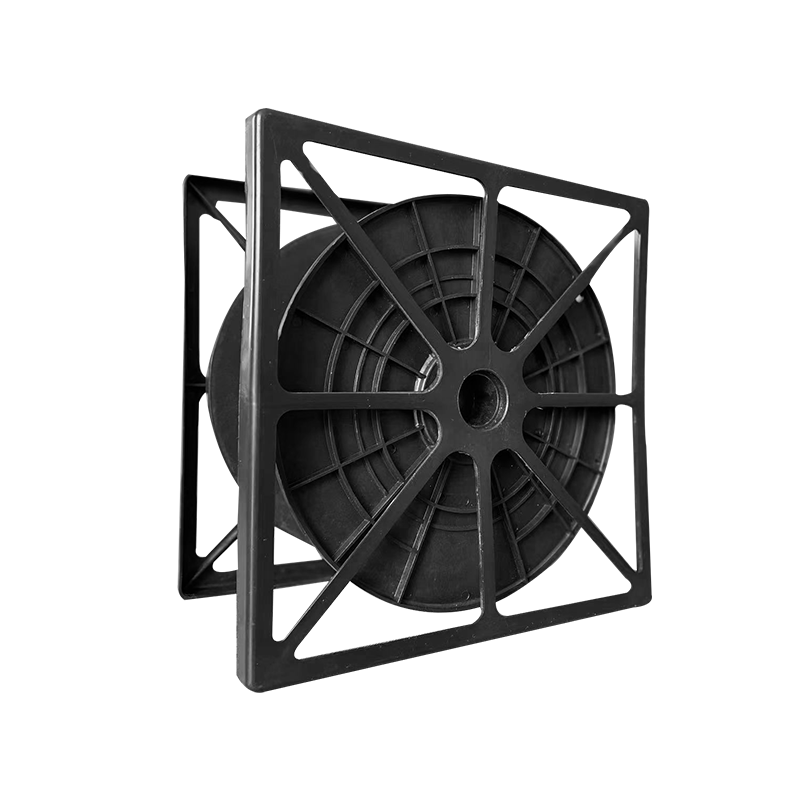 Moisture-Proof Plastic Cable Reel for Damp EnvironmentsThis engineering plastic reel ignores water and detergents that attack painted steel, making it a reliable choice for washdown areas and humid storage conditions.View Product →
A reel matched to its environment stays straight on the wall through years of temperature swings and washdowns.
A reel is only as good as the hose it carries, and the hose works only when its size matches the tools. Three numbers matter: inside diameter, working pressure, and length.
Inside diameter is the first filter. A 1/4-inch hose handles blow guns and tire inflation. A 3/8-inch hose is the standard for impact wrenches and ratchets up to about 12 CFM. A 1/2-inch hose covers sanders, die grinders, and continuous-use tools that draw more than 12 CFM.
| Hose ID | Practical Length | Typical Tools | Continuous Flow |
|---|---|---|---|
| 1/4 in | 25–50 ft | Blow guns, tire inflation | Up to 6 CFM |
| 3/8 in | 50–75 ft | Impact wrenches, ratchets | 6–12 CFM |
| 1/2 in | 75–100 ft | Sanders, grinders | 12–20+ CFM |
Buy a hose and reel rated to at least 200 PSI even if the compressor runs at 120 PSI; the swivel and couplers see the same pressure pulses and a higher-rated part costs little more. Pressure rating alone will not save a small compressor, though. If the compressor delivers 7 CFM at 90 PSI, a 1/2-inch hose will not create enough flow for a sander that needs 11 CFM—it just delivers what exists with less restriction. Start from the tool's CFM requirement, then choose the hose, then match the reel to it.
Mount spring rewind reels at 8 to 10 feet above the floor so the hose pulls down at a shallow angle and the whip end sweeps above head height. Ceiling mounts work well in wide bays but need a guide ring to stop the hose from rubbing against a wall edge. On service trucks, mount the reel vertically on a reinforcing plate rather than the body skin.
Feed the reel through a shut-off valve and a short whip hose instead of a rigid pipe. The reel swivels slightly in normal use, and a rigid connection will fatigue. The valve also lets you drain the line and replace the reel without bleeding the whole tank.
A hose reel has few moving parts, which is why the few it has deserve attention. Swivel seals, O-rings, and the spring are what age. The maintenance routine is short:
When a reel sits idle for weeks, leave the hose unlatched and loosely wound, not tensioned. The same handling and storage best practices used for large cable drums apply here: keep the assembly off the ground, protect the flange edges from impact, and keep the pivot dry. That discipline is what lets a reel survive several compressor replacements.
An air compressor hose reel will not add CFM to a small compressor, and no spring can make up for a hose that is several sizes too large. But when the mechanism, drum material, hose size, and mount position are matched to the work, the reel outlasts the compressor feeding it. Work through the four decisions in the order covered here, and the unit you install becomes one of those fixtures you stop thinking about—which is exactly the point of owning it.
Related Products

Contact us
Address
No. 19, Hualong Industrial Park, Linglong Street, Lin'an District, Hangzhou City, Zhejiang Province, China
Phone
+86-13357115977
QR CODE
 Cable Reel Manufacturers, Cable Packaging Reel Factory

 English
 中文简体
中文简体